Keywords
security
trust
new paradigm
trust
new paradigm
How to Cite
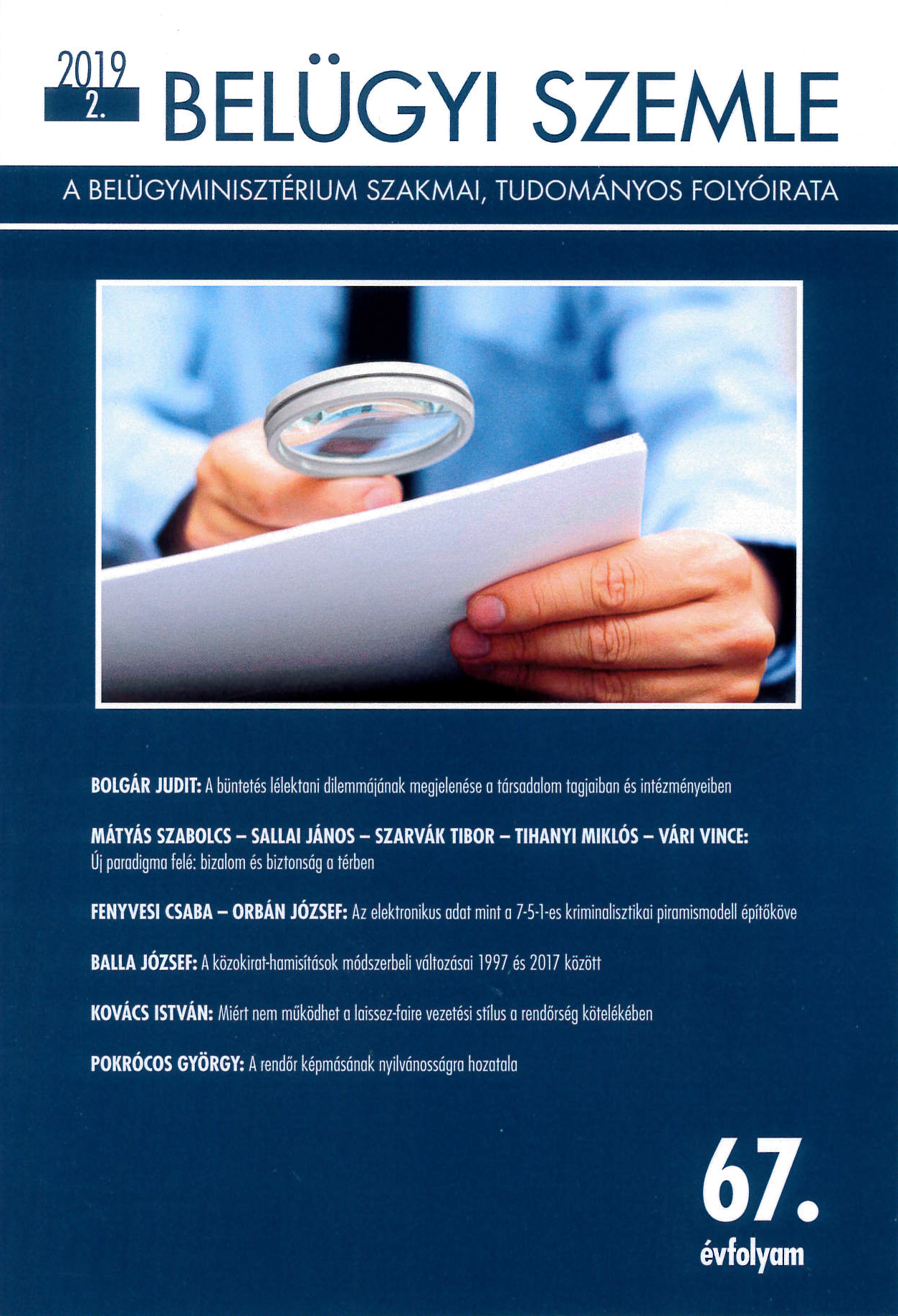
Towards a new paradigm: trust and security: Some questions about the relationship between the social frameworks that determine the functioning of a law enforcement organization. (2019). Academic Journal of Internal Affairs, 67(2), 22-44. https://doi.org/10.38146/BSZ.2019.2.2
Abstract
The authors provide an overview of the importance and interrelation of trust and security in a democratic society governed by the rule of law.
References
Downloads
Download data is not yet available.
Similar Articles
- Tamás Somogyi, Rudolf Nagy, Cooperation between tourism and financial sector in order to increase the level of security , Academic Journal of Internal Affairs: Vol. 73 No. 5 (2025)
- Zsolt Lippai, Kund Regényi, Károly Csatári, Tamás Nagy, Examination of the Budapest Party District from the perspective of private and public security , Academic Journal of Internal Affairs: Vol. 71 No. 2.ksz. (2023): Special Issue
- Petra Szalai, Security and Crisis Management, Components of Economic Crises , Academic Journal of Internal Affairs: Vol. 68 No. 3. ksz. (2020): Special Issue
- Zsolt Lippai , On state and non-state actors in creating and maintaining security , Academic Journal of Internal Affairs: Vol. 71 No. 8 (2023)
- Zsolt Lippai, László Christián, Security rethought, research report , Academic Journal of Internal Affairs: Vol. 71 No. 1 (2023)
- Ádám Kalmár, Law enforcement cooperation in the framework of the Danube Strategy , Academic Journal of Internal Affairs: Vol. 70 No. 12 (2022)
- Béla Danielisz, Necessity for paradigm shift in the approach of urban security's interpretation , Academic Journal of Internal Affairs: Vol. 68 No. 1 (2020)
- Gábor Mészáros, Péter Felföldi, On the motorway safely? , Academic Journal of Internal Affairs: Vol. 69 No. 6 (2021)
- Bendegúz Papp, Some interpretations of the State-of-the-Art of law enforcement science and its security policy aspects , Academic Journal of Internal Affairs: Vol. 68 No. 2 (2020)
- Mónika Füstös, Trust in the police and willingness to report crimes. A systematic literature review based on Web of Science , Academic Journal of Internal Affairs: Vol. 70 No. 1 (2022)
You may also start an advanced similarity search for this article.
Most read articles by the same author(s)
- Ernő Krauzer, János Sallai, Lajos Szamel, the establisher and messenger of law enforcement science , Academic Journal of Internal Affairs: Vol. 69 No. 9 (2021)
- Miklós Tihanyi, Developing local police units: intelligence-led policing , Academic Journal of Internal Affairs: Vol. 61 No. 6 (2013)
- Violetta Rottler, János Sallai, When changes went into effect: Hungarians from Transylvania permitted to cross the Western border from 1985 , Academic Journal of Internal Affairs: Vol. 68 No. 2. ksz. (2020): Special Issue
- Szabolcs Mátyás, Prisoners’ approach to CCTV , Academic Journal of Internal Affairs: Vol. 68 No. 2 (2020)
- Miklós Tihanyi, Dávid Papp, History of the Neighbourhood Police Officers’ Service 2. From the beginning to the regime change , Academic Journal of Internal Affairs: Vol. 70 No. 4 (2022)
- Vince Vári, Crimes related to new psychoactive substances in rural segregates of Miskolc in Hungary , Academic Journal of Internal Affairs: Vol. 70 No. 2. ksz. (2022): Special Issue
- Miklós Tihanyi, Public order and public safety in Christian ethics , Academic Journal of Internal Affairs: Vol. 65 No. 3 (2017)
- János Sallai, Accreditation of the Hungarian law enforcement science , Academic Journal of Internal Affairs: Vol. 67 No. 10 (2019)
- Szabolcs Mátyás, The History of Law Enforcement in Hungary , Academic Journal of Internal Affairs: Vol. 66 No. 11 (2018)
- Szabolcs Mátyás, Settlement structure and criminality: the case of the Hungarian capitol , Academic Journal of Internal Affairs: Vol. 66 No. 5 (2018)